
December Creative Prompts
Five Prompts to Bring you Closer to your Corner of the Earth

I am a city person mostly against my will.
It’s true that I’ve grown soft and accustomed to taking the train to an international airport rather than taking a Greyhound 190 miles down the mountain, and walking to Walgreens for emergency rations when the cupboards are bare from bad planning rather than having to drive twenty minutes to the grocery store.
But it’s also true that I only moved here because the wages were higher and the cost of living lower than where I had been living.
I grew up on a slow, wide, Southern river, where every morning the fog snaked through the green hills above the water. I spent my young adulthood in the mountains of the Southwest, learning the texture of horny toads and how to navigate the loose earth of a scree hill.


The closest I’ve come to any of that in the city is when I put three birdfeeders in my apartment building’s yard. My favorite clientele were the round little red-headed fir finches. They came in enormous groups, feasting until they were inevitably intimidated away by robins. This project lead to mourning doves roosting in the eaves of the top floor porches of the building and peregrine falcons hunting the small birds I’d attracted via boughs of established trees out front.
My neighbors were generous about these inconveniences, but it was clear that having this many birds in close proximity was taxing folks’ patience. I even heard one resident complaining about the birdsong in the morning. They found it to be too loud.
Kate Yoder at The Grist wrote a recent piece that went semi-viral about how “the words we use to talk about nature are disappearing."1 The overarching assumption, of course, is that this reflects our continuing and alarming distance from “the natural” as we move in ever-tigher circles, like dogs trying to find the most comfortable arrangement for rest, in our manufactured environs.
That 2026 will be the final Farmers Almanac publication brings this in to sharp focus. Who needs to know the ideal dates to plant wheat in these days of industrial agriculture and laptop-connected work days?
This phenomena, the shrinking presence of what we might call nature in our written word, has emerged as a concern many times since the Industrial Revolution of the 18th century, when the weaving machines moved in and started taking out the cottage industries, ruining the bucolic village vibes.
One of my favorite pieces that spells out that long history is Mary McCarthy’s One Touch of Nature (written in 1970). In it she notes that in 20th century texts when nature is present at all it is not “normal,” but rather a dangerous and “hallucinatory presence” that factors into characters being moved to insanity or evil.
In other words, it’s a long sordid way from Wordsworth’s Daffodils to the overpowering sun in Camus’s The Stranger.
In making Demon Mineral, connecting viewers to The Land was of primary importance to me. My overarching question during production and editing was: How can I make someone care about a place they’ve never been to and may never visit?
With my current projects, one about a giant boulder in NYC and another about the past, present, and future of the Appalachian metallurgical coal fields that question remains a driving determinant.
And so, with this in mind, as we make our way to a New Year (be it Gregorian, lunar, or lunisolar) here are prompts to bring you closer to nature and, as with all my prompts in this project, encourage you to slow the fuck down and bring your mind to a more centered and creative space.
1. Copy a description of nature written by an author you admire
I listened to a podcast that, despite its sort of unkind and unauthorized dig into Donna Tartt’s life, was riveting. With my headphones in and while I was deep cleaning my kitchen floor I learned that Jonathan Lethem wrote out whole passages of Joan Didion’s work to learn to write like her. This struck me as funny, since Didion was very open about having done the same with Hemmingway’s work.
This practice of copying eventually making perfect is an old one, though not one often used these days.
And yet, perhaps it is just the sort of practice to remind us how to write about nature. To reteach us the words we’ve forgotten. Or to teach us words we never knew. I learned what a veld was by reading Doris Lessing’s Martha Quest, for instance.
Lessing is a good place to start if you are wanting some nature descriptions; her language is transportative, doing for the African velds what I hope to do with my own work. Another place to look if you’re wanting to hang out in the fiction space is Wallace Stegner.
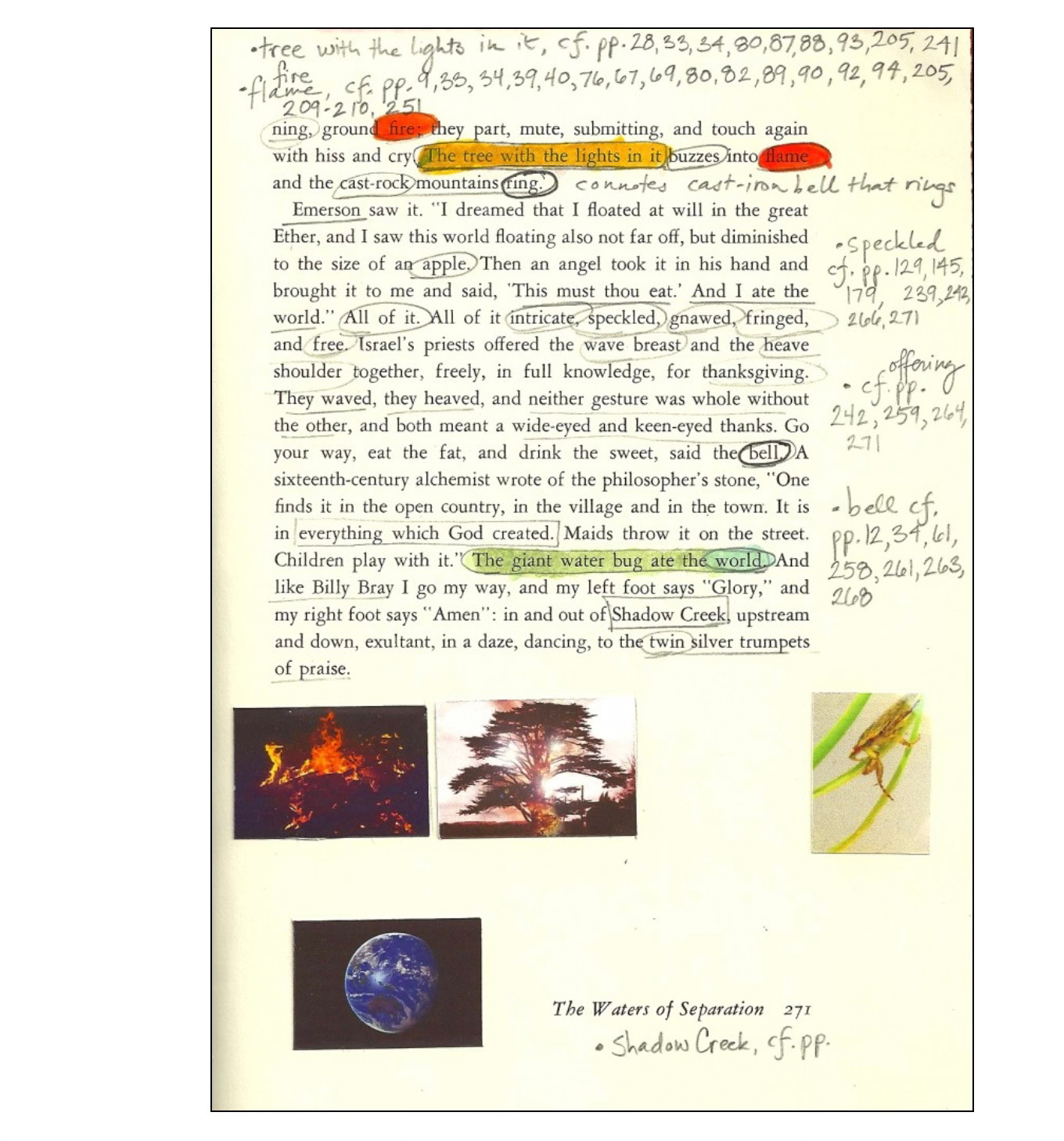
For non-fiction I suggest Annie Dillard’s Pilgrim at Tinker Creek (in fact, I used to use a passage from this text about the blood vessels in her goldfish Ellery’s fins when teaching descriptive writing, and read another passage about locusts at the leftist Seders my partner used to coordinate). Other contemporary non-fiction nature texts to start with are Cal Flyn’s Islands of Abandonment or Nick Hayes’s The Book Of Trespass: Crossing the Lines that Divide Us.
Gigantic Cinema: A Weather Anthology is also wonderful fun, should the weather be of special interest to you.
2. Layer up and sit outside
Sit and observe outside for a minimum of ten minutes. Leave your phone in the house or the car. You need not make big effort. You can be anywhere; your backyard, or a park. It need not be somewhere grand, though lucky you if it is.
List all that you observe: the quality of the air, the smells, the sounds, the animals, the plants that continue to persevere in this darker season (describe them if you cannot name them; you can always do an Internet search after coming indoors).
3. Research where your water originates
Your water is made and at some point in its journey stored by the Earth. Knowing your water sources is a practical concern but also an existential one. Knowing what surface and ground water sources make their way to your personal tap will bring you closer to your corner of the Land.
Extra points if you go and visit one of your water sources.
Some places to start your research are the EPA (for now, anyway; their content is being scraped by the day) and the NEEF.
4. Look Up
Kids overwhelmingly want to play outside with their friends rather than be stuck indoors with screens, but they aren’t permitted to do so.
The Harris Poll that resulted in the many articles written on this subject made me think of laying on my back in the dirt, looking up at how leaves and branches moved with the wind, noting shapes of clouds.
Do kids still chat with each other about whether a cloud looks like a dragon or a rabbit? Are they allowed to?
Day or night, leave the phone somewhere else, step outside, exercise your freedom, and look up.
5. Make an ekphrastic work in response to local birdsong
Download the Cornell Lab of Ornithology Merlin Bird ID app and learn which birds are around you.
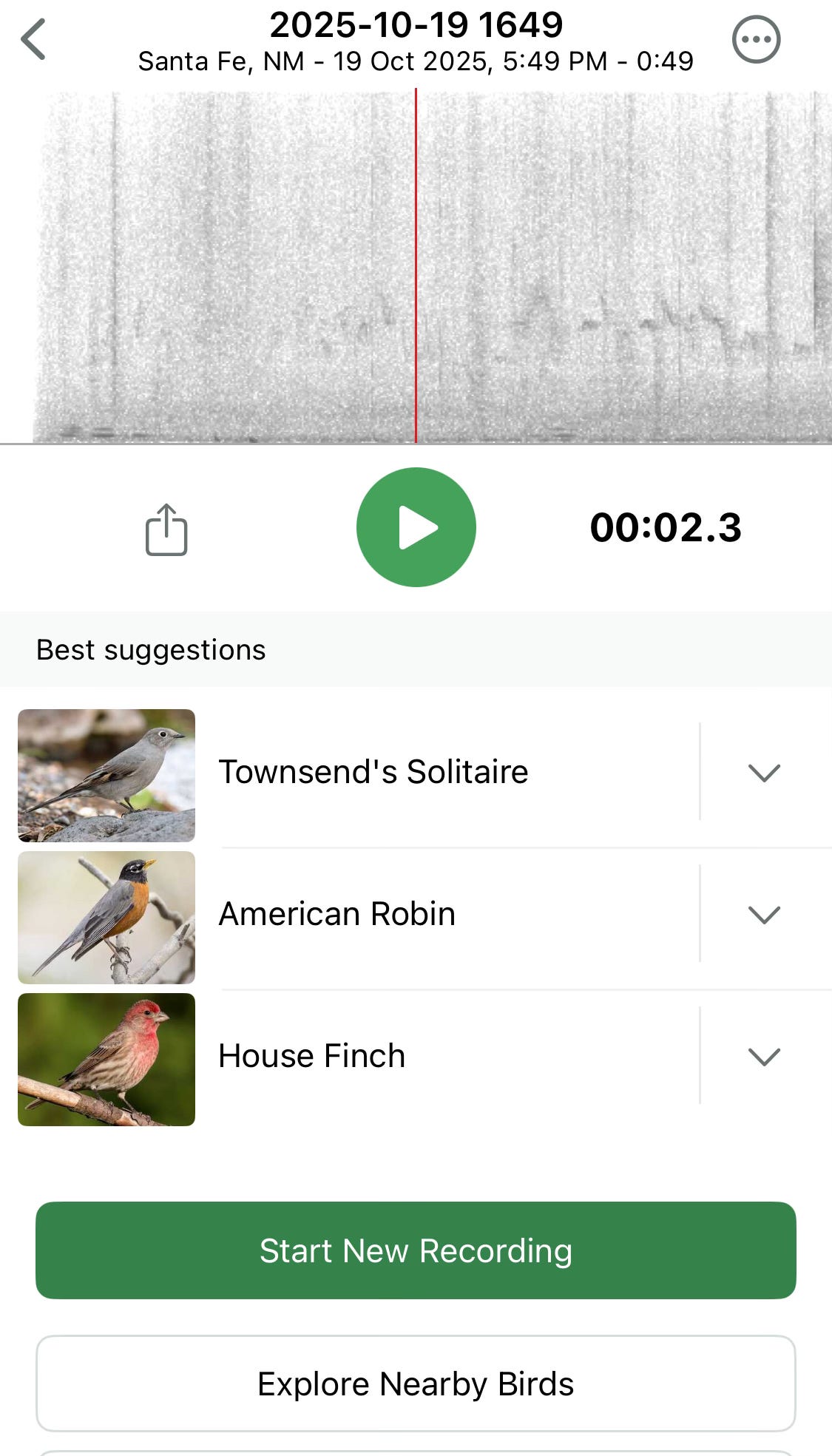
Make an ekphrastic work in response to their song.
Ekphrasis, generally defined as a written work in response to a visual work of art, here is of course expanded. The art is the birdsong and the ekphrasis can take any form. The point is to listen and then respond.
Updates:
Yoni’s game, Chicago ‘68, is out and doing well. If you want to get a copy for yourself or someone in your life you can do so here.
We got a new feline companion. Thanks to her desire to destroy my beloved vintage speakers and also any and all cloth furniture she has been christened Zenobia Hellbender. If you have any tips for deterring destructive scratching do reach out. We have tried the double sided tape and tin foil. She has been provided a variety of acceptable scratchers.

A while ago I had the good fun and fortune to be on CounterPunch but got slammed with work and forgot to tell folks. I mistakenly say “unmediated” instead of “unreclaimed" at one point, which is mortifying, but it was a good time and you can listen to it here or anywhere you get your podcasts.

Currently Reading:
In the Kitchen:
It’s been noodle mania over here, much of it ad-hoc and just using what came in our local CSA. One that we make on repeat, though, is the miso caccio e pepe from Hetty McKinnon’s To Asia, With Love. I replace the udon with bucatini.


The study that the article is responding to is this one from Earth Journal.