Wet Plate
Immortality, My Back Right Molar, and Analog Tech

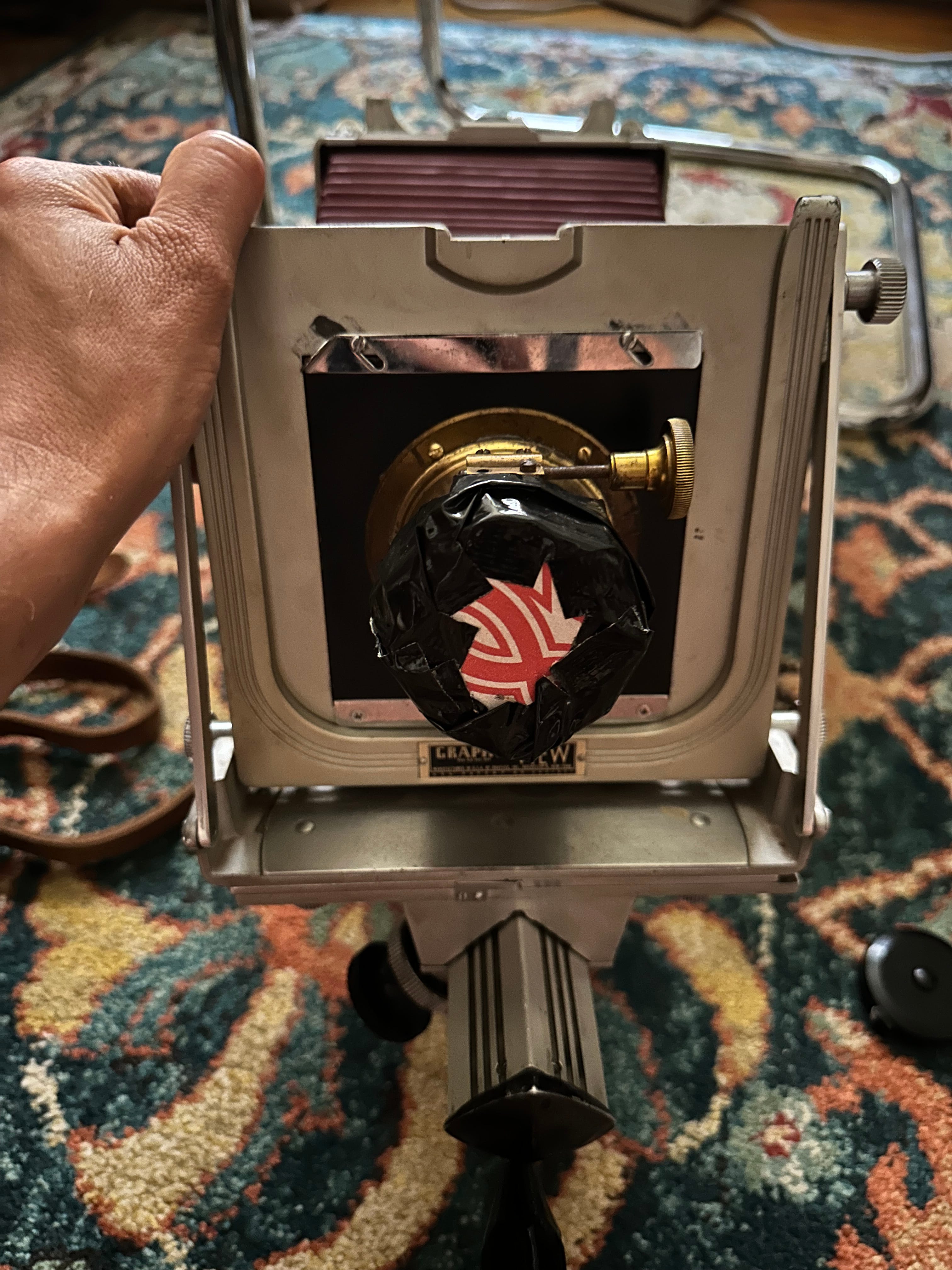
I bought a 200 year old French lens off ebay while visiting my family for Christmas.
“You don’t mind that I’m spending this money, do you?” I asked my partner.
My parents looked at each other bemused, and my partner shrugged with a relative disinterest.
It wasn’t disinterest in the endeavor, it was the disinterest that accompanies the habitual. Usually it’s him showing me a lens. Some cool thing we’d have to go to Antwerp to obtain. And my response is always, “If you want it, let’s make it happen.”
So far, aside from a $400 contemporary lens purchased like a drug deal with cash in a rural Michigan parking lot, he’s not yet taken me up on the offer. But he knows I mean it.
Who knows what images my old French lens has captured in its long life?
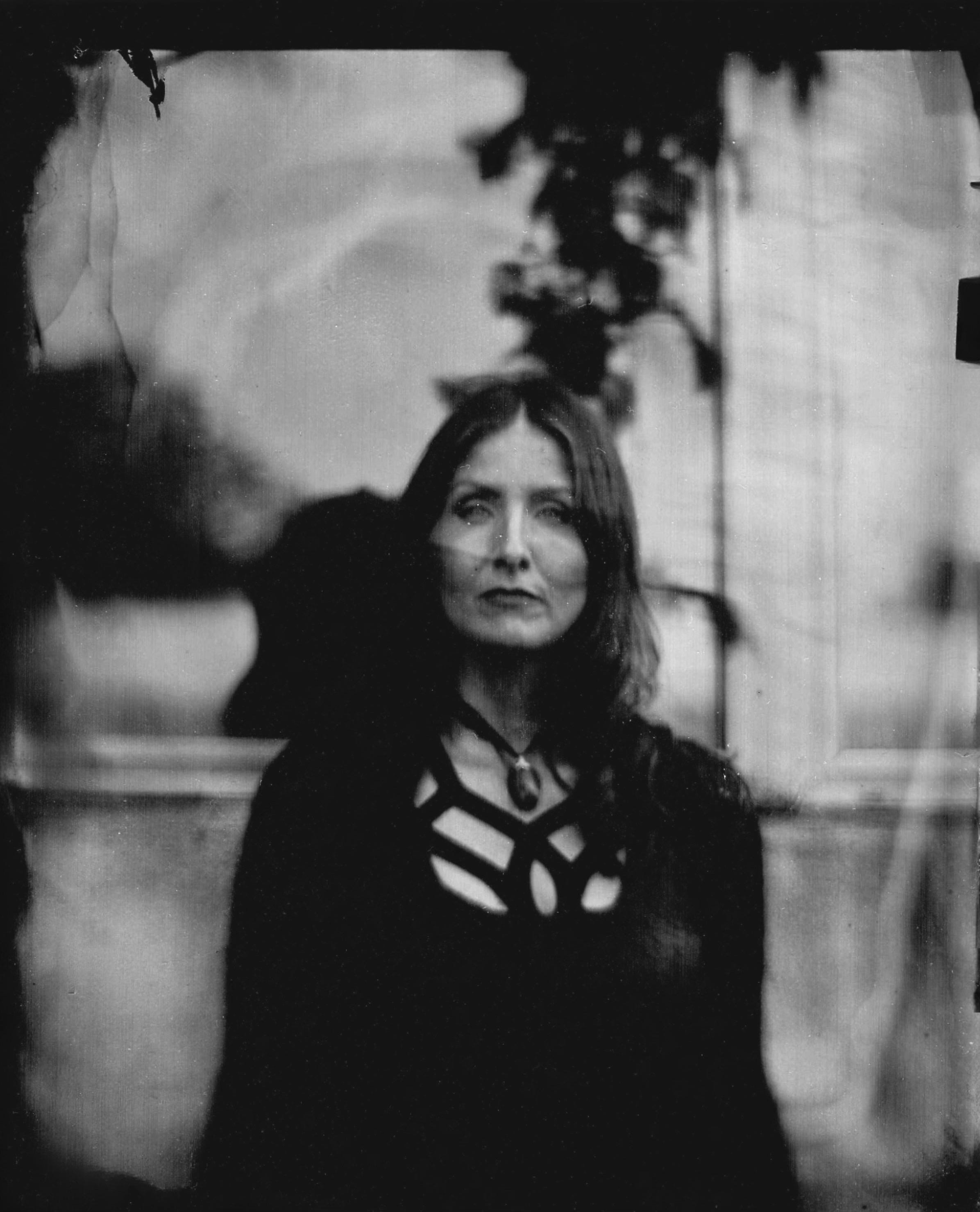
What I do know is now I’m using it to document my friend/neighbor/former student holding her Gameboy.
I also know I’m relatively new to this method, so this lens is starting over with an inexperienced technician for what is most certainly not the first time.

The lens cap was long lost to history, so I fashioned one out of an Ale81 case and some duct tape. I hope the indignity doesn’t feel too great. Most certainly the lens deserves more grandeur.
I’m currently reading Sally Mann’s Art Work, and in it she notes that these days you can’t hardly spit without hitting a wet plate photographer.
Back when she was reviving the medium it was, of course, a rarity.
Still, it’s not like she was the only one. Collodion processing has been hanging on since 1851.
Its relevance persists in part due to the quality of images it produces: the shimmer of the silver and the ghostly way it handles color transport temporally and emotionally. There’s also the satisfying tactile quality of creation, from the coating of the plate to the focusing of the shot; in this increasingly digital moment it is comfortingly of this Earth and hands-on.
All that being true, the real reason this method has never fully fallen into obscurity is thanks to its creator, Frederick Scott Archer, never patenting it. The OG open-source guy, he was convinced that keeping the technology available to all would advance photography. He was, of course, right. And because the method could be practiced by anyone anywhere it was, and the tradition lived on while other methods fell into obscurity, their complex chemical requirements lost to time.
Archer died in poverty.
Let us be clear: he did not fail. Society failed him.
I think of him every time I pull a plate.
Some of you may have landed here through my work as a filmmaker; if that’s the case you may assume that my primary image-capturing practice is with a cinema camera.
While it’s true that I often use that camera for money-making work (another post on how this artist actually pays her bills may be in order), my partner is actually my cinematic eye.
I do the research, I make the connections with people and places, I organize our production trips, and then I plop him in front of a landscape or a person or a whatever and say, “This is what we are capturing today.” He then does so deftly and with grace.
Yes, I am very lucky. Really, I don’t think anyone has ever been as lucky as I am.
Despite not shooting my own films, I have since childhood had an image-making practice. Mostly it has involved old manual cameras with cheap lenses and expired film developed by the sweet guys at Central Camera or, long ago, the same-day folks at Walgreens.
It will surprise no-one to learn that I spent a lot of time alone in the dark room in both high school and college. I still have a cotton cardigan from that time, the cuffs stained with developing fluid.
These days my partner patiently tolerates me converting the bathroom to a darkroom and walking around with someone whose hands look like this all the time.
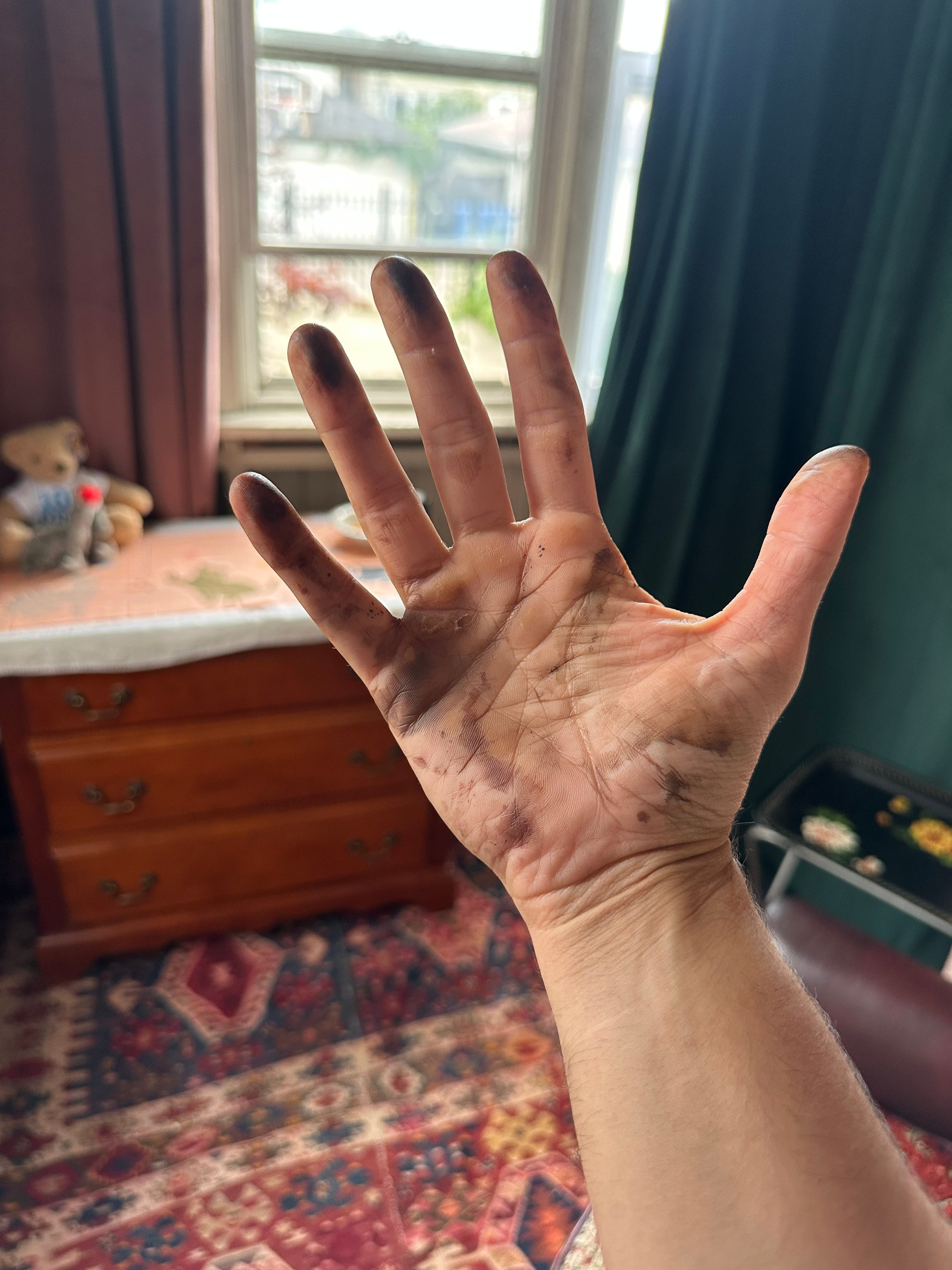
Turns out you get even more developer fluid on you with tin type processing than in dark room film processing.
I have also had a long habit of picking up old cameras from the thrift store and cleaning them up, rewiring them for contemporary batteries, and using them until I gifted them to someone else.
One day not long after I started my wet-plate endeavors I was going for a walk and the house three doors down had a Tupperware bin full of old cameras on the sidewalk. A gift from the universe just for me. They were moldy and sad except for one medium format with an 1930s Zeiss lens perched pristinely atop the riffraff. The set-up turned out to be for macro capture. I wonder who once owned it. Did they photograph flowers or bugs?
I used it to photograph these old letterpress letters to make an anniversary gift for my partner.

I find comfort in these, and other, old things. The mid-century chairs in my apartment, the century-old crystal glasses we drink wine out of when we are feeling fancy, the ‘70s Western stage wear I’ve repurposed for every-day.
Sometimes, though, like when my tongue finds the rough, decalcified corner of my back right molar, I am reminded that these things will live longer than me.
I didn’t make that French lens or that German macro camera, but I am their current keeper. They will, barring disaster and with reasonably kind care, last another century.
This would feel sad and grim to many, but to me it is a comfort. A way of crisscrossing one of the greatest divides.
And perhaps someone (I have chosen not to have children, so it will likely be a stranger) will pick them up and still be able to use them thanks to my stewardship and the generosity of Frederick Scott Archer.
I’m not so certain about these indulgent posts sort of about nothing! But they feel like old school Blogger days so I’ll hang for now.
Anyway, some recipes we’ve been enjoying: